Decentralized Autonomous Organizations (DAOs) were built on a simple promise: distribute power, eliminate central control, and let communities govern themselves.
But the reality tells a very different story.
Despite collectively managing over $25 billion in treasury assets, DAO governance is overwhelmingly concentrated. According to NS3.AI, less than 1% of token holders control roughly 90% of the voting power across many of these organizations. In practice, that means a tiny elite is steering decisions for ecosystems worth billions.
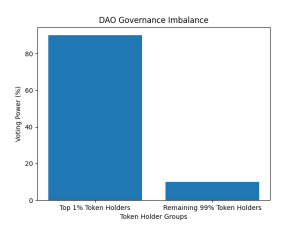
DAOs manage over $25B in assets, but less than 1% of token holders control 90% of voting power, with participation rates as low as 5%.
This isn’t decentralization—it’s plutocracy, rebranded on the blockchain.
Even more concerning is the lack of participation. Most DAOs see voter turnout between just 5% and 15%, leaving governance decisions in the hands of a small, highly active minority. The vast majority of token holders remain passive, disengaged, or simply priced out of meaningful influence.
And when it comes to execution, the system looks even less “decentralized.” Many DAOs still rely on 3-of-5 multisignature wallets to move funds—effectively placing operational control in the hands of just a few individuals. While this setup offers security, it reinforces the very centralization DAOs were meant to eliminate.
The uncomfortable truth is that DAOs are facing a structural contradiction: efficiency and security often require centralization, while true decentralization can slow decision-making to a crawl.
Until this tension is resolved, DAOs risk becoming what they originally set out to disrupt—systems where power is concentrated, participation is limited, and governance is more symbolic than real.
The question now isn’t whether DAOs can scale. It’s whether they can actually decentralize.