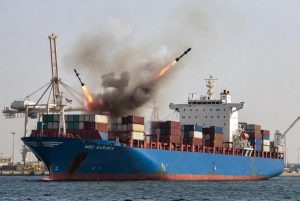
A cargo vessel operated by Mediterranean Shipping Company (MSC), the MSC Sariska V, was struck by two projectiles near Iraq’s Umm Qasr port on June 1, according to a statement released by the shipping giant on June 2. The company confirmed that all crew members were safe and described the incident as an unprovoked attack on a neutral commercial carrier. Reports indicate that Iran’s Revolutionary Guard Corps (IRGC) has claimed responsibility for the strike.
Missile Strike on MSC Cargo Ship Near Iraq Raises Global Trade Concerns and Could Boost Bitcoin Safe-Haven Narrative
While the immediate focus remains on maritime security and the safety of the crew, such incidents often have broader implications for financial markets. Attacks on commercial shipping routes can increase concerns about supply chain disruptions, rising insurance costs, and potential interruptions to global trade.
The strike occurred in a region that remains strategically important for energy exports and international shipping. Investors typically react cautiously when geopolitical tensions threaten key maritime corridors, particularly in the Middle East, where a significant share of global oil and commodity shipments transit.
For traditional financial markets, heightened geopolitical uncertainty often leads to increased volatility. Investors may move capital away from risk assets and toward perceived safe havens such as gold, government bonds, and, increasingly, Bitcoin.
The cryptocurrency market has historically shown mixed reactions to geopolitical crises. In the immediate aftermath of major security incidents, digital assets can experience short-term selling pressure as investors reduce exposure to risk. However, prolonged geopolitical instability, concerns over inflation, disruptions to energy supplies, or declining confidence in traditional financial systems can strengthen the narrative surrounding Bitcoin as a decentralized store of value.
Shipping disruptions can also influence inflation expectations. If attacks on commercial vessels become more frequent, transportation costs and insurance premiums could rise, ultimately increasing prices for goods and commodities. Such inflationary pressures may reinforce interest in scarce digital assets, particularly Bitcoin, which many investors view as a hedge against currency debasement.
The incident involving the MSC Sariska V therefore serves as another reminder that geopolitical tensions extend beyond regional security concerns. They can influence global trade, energy markets, investor sentiment, and ultimately the performance of both traditional and digital assets.
As markets continue to monitor developments in the Gulf region, crypto investors will be watching closely to see whether rising geopolitical uncertainty strengthens demand for decentralized assets or triggers a broader risk-off environment across global markets.