
AI and Data Control: From African Union Servers to YouTube Training | HighwayCrypto.
Artificial intelligence is often framed as a breakthrough in computing power. Less examined is the infrastructure beneath it: the movement of data across borders, systems, and jurisdictions.
As adoption accelerates, a more fundamental issue is emerging—who controls the flow of data.
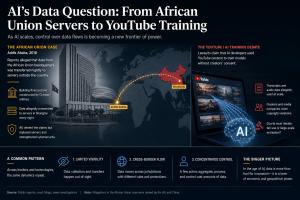
As AI scales, control over data flows is emerging as a new frontier of power.
An early signal came in 2018, when reports about the African Union headquarters in Addis Ababa alleged that internal data had been transferred nightly to external servers. The building, financed and constructed by Chinese entities, became the focus of concerns about hidden access to sensitive information.
Both China and the AU denied the claims, and the episode remains disputed. Yet the response—server replacements and tighter cybersecurity—underscored a broader point: infrastructure can shape data flows in ways not immediately visible to its users.
Today, similar questions are playing out at a different scale.
AI developers, including OpenAI, rely on vast datasets to train increasingly capable models. These datasets often combine licensed material with publicly available content, assembled through processes that remain only partially disclosed.
That opacity is now being tested in court.
Lawsuits involving content creators and media organizations have raised concerns that material from platforms such as YouTube may have been used to train AI systems without explicit consent. At issue is whether such use constitutes fair use—or a new form of large-scale extraction in the digital economy.
The outcome could reshape both intellectual property law and the economics of AI.
Across these cases, a consistent pattern emerges. Data is collected with limited visibility, transferred across jurisdictions, and consolidated by a small number of actors with the capacity to process it.
For policymakers, this raises questions of digital sovereignty. For creators and institutions, it highlights a widening gap between those who generate data and those who control its use.
The contrast is particularly sharp in the context of crypto and Web3, where systems are designed around transparency and ownership. AI, by comparison, continues to evolve within centralized data ecosystems.
The debate is no longer just about privacy or innovation. It is about economic structure.
In the AI era, control over data flows is fast becoming a proxy for control over power itself.