
Gold is experiencing a rare and prolonged downturn, marking its longest losing streak in over a century. The precious metal has now declined for 10 consecutive days—its worst stretch since 1920—raising fresh questions about its role as a safe-haven asset in today’s evolving financial landscape.
At the same time, Bitcoin continues to demonstrate resilience, holding firmly above the $70,000 level. The divergence between the two assets is becoming increasingly pronounced, with analysts from Bloomberg and NS3 highlighting a notable shift in investor sentiment.
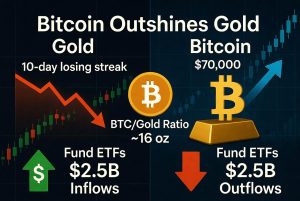
Gold suffers its longest losing streak since 1920, while Bitcoin holds firm above $70,000. The BTC/Gold ratio nears 16 ounces as investors pour $2.5B into Bitcoin ETFs and pull billions out of gold ETFs.
One key metric drawing attention is the Bitcoin-to-gold ratio, which is now hovering near 16 ounces. This means a single Bitcoin can purchase approximately 16 ounces of gold—underscoring Bitcoin’s relative strength during gold’s decline.
Investor flows further reinforce this trend. Bitcoin exchange-traded funds (ETFs) have attracted roughly $2.5 billion in inflows this month, signaling sustained institutional interest. In contrast, gold-backed ETFs have recorded billions of dollars in outflows in just the past week, suggesting that capital is rotating away from traditional stores of value.
This divergence reflects a broader transformation in how investors perceive risk and preservation of wealth. While gold has historically been the go-to hedge during uncertainty, Bitcoin is increasingly being viewed as a digital alternative—offering portability, scarcity, and growing mainstream acceptance.
As macroeconomic conditions evolve and market participants reassess their strategies, the contrasting trajectories of gold and Bitcoin may signal a deeper shift in global investment preferences—one where digital assets continue to challenge long-standing financial norms.