At the annual Ethereum Community Conference in Cannes, leading blockchain contributors including Gnosis, Zisk, and the Ethereum Foundation unveiled a new initiative aimed at solving one of Ethereum’s most persistent challenges—fragmentation across layer 2 networks.
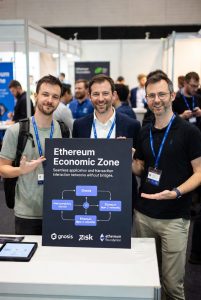
Gnosis, Zisk, and the Ethereum Foundation officially unveil the Ethereum Economic Zone at EthCC in Cannes.
This new initiative aims to create seamless interoperability between Ethereum Layer 2 networks — enabling applications and transactions to interact directly without bridges, while preserving Ethereum’s core security and keeping ETH as the primary gas token.
A major step toward a more unified and efficient Ethereum ecosystem.
Dubbed the Ethereum Economic Zone (EEZ), the framework is designed to enhance interoperability between Ethereum layer 2 ecosystems, enabling applications and transactions to function seamlessly across multiple networks.
Breaking Down Silos in Layer 2
Ethereum’s scaling roadmap has heavily relied on layer 2 solutions such as rollups. While these networks significantly reduce costs and increase throughput, they have also introduced fragmentation—forcing users and developers to rely on bridges to move assets and data between chains.
The Ethereum Economic Zone aims to eliminate this friction.
Instead of requiring bridges, the EEZ framework allows different layer 2 networks to interact natively. This means users could move assets, execute transactions, and use decentralized applications across ecosystems without the complexity and risks typically associated with bridging.
Preserving Ethereum’s Core Principles
A key feature of the initiative is its commitment to maintaining Ethereum’s foundational security model. The EEZ will continue to anchor itself to Ethereum’s base layer, ensuring that security guarantees remain intact.
Additionally, ETH will remain the primary token for transaction fees, reinforcing Ethereum’s economic cohesion even as activity expands across multiple layer 2 environments.
A Step Toward a Unified Ethereum Ecosystem
By reducing fragmentation and improving cross-network usability, the Ethereum Economic Zone could mark a major step toward a more unified Ethereum experience.
If successful, the initiative may accelerate adoption by simplifying how users and developers interact with the broader ecosystem—bringing Ethereum closer to operating as a single, cohesive economic layer rather than a collection of isolated networks.